

If you’ve been charged with unlawful possession of a firearm in Texas, you could be facing felony penalties, prison time, and the permanent loss of gun rights.
Texas has constitutional carry laws but not everyone can legally possess a firearm. Many people are arrested during traffic stops, domestic disputes, or routine police encounters without realizing they were prohibited from having a gun.
An experienced Texas criminal defense attorney can review whether the arrest, search, and charge are legally valid.
Common Situations Leading to Bexar County Gun Charges
Unlawful Possession of a Firearm
Traffic stop - including DWI - with firearm in vehicle
Possession of marijuana and a firearm (even if marijuana charge dropped)
Domestic disturbance call
Execution of a search warrant
Protective order violation
Prior felony record discovered during investigation
A careful review of the evidence can reveal weaknesses in the prosecution’s case. Contact Mayes Law to discuss your gun charge in San Antonio.
Penalties for Unlawful Possession in Bexar County
Gun Charge Defense in Bexar County
Third-Degree Felony
Under Texas law, a person convicted of a felony may not possess a firearm:
For five years after release from confinement, parole, or supervision; and
After that five-year period, only at the person’s residence.
If the State alleges you possessed a firearm outside those limits, the charge is typically a third-degree felony, punishable by:
2 to 10 years in prison
Up to a $10,000 fine
But in practice, these cases are rarely as simple as “a felon had a gun.”
Constructive Possession in Vehicle Cases
Many arrests in San Antonio happen during routine traffic stops.
Police may discover a firearm:
In a glove compartment
Under a seat
In a center console
In a backpack or gym bag
In a vehicle occupied by multiple people
In these situations, the issue becomes possession.
Texas law does not require the State to prove you owned the firearm. Instead, prosecutors attempt to prove you:
Exercised care, custody, control, or management over it; and
Knew it was present.
This is known as constructive possession.
Class A Misdemeanor
Not all firearm offenses are felonies. In Bexar County, certain unlawful carrying or possession violations are charged as Class A misdemeanors, depending on the circumstances.
Common examples include:
Carrying a handgun into a location that is legally prohibited (such as certain government buildings, bars deriving 51% of income from alcohol, or polling places)
Carrying while intoxicated
Carrying in violation of specific statutory restrictions despite Texas’ permitless carry laws
Certain protective-order-related possession violations that do not rise to felony level
Even though Texas is a constitutional carry state, that does not mean firearms are permitted everywhere or under all conditions. Location, intoxication, and prior history still matter.
A misdemeanor conviction may also result in:
Loss of concealed carry eligibility
Restrictions on future firearm possession
Increased penalties if charged again
Immigration consequences in some cases

The US Constitution and Gun Charges
The Second Amendment to the United States Constitution protects the right to keep and bear arms. Texas law also recognizes strong firearm rights.
But like most constitutional rights, the Second Amendment is not unlimited.
Courts have consistently held that certain categories of individuals (including convicted felons and persons subject to certain protective orders) may be lawfully restricted from possessing firearms.
At the same time, constitutional protections still apply in every gun case.
Even when a person is prohibited from possessing a firearm, the State must prove:
The law actually applies to that individual
The person knowingly possessed the weapon
The search and seizure complied with constitutional standards
The Second Amendment does not eliminate criminal statutes. But it does require courts to carefully examine whether restrictions are lawful and properly applied.
The Fourth Amendment to the United States Constitution protects individuals from unreasonable searches and seizures. In firearm cases, this protection is often just as important as the Second Amendment itself. Police must have lawful authority to stop a vehicle, detain an individual, search a car or home, or seize a weapon. If a traffic stop was unsupported by reasonable suspicion, if consent to search was not voluntary, or if officers exceeded the lawful scope of a detention, the discovery of a firearm may violate constitutional standards.
In unlawful possession cases, courts closely examine how the weapon was found. The State must show that the stop, search, and seizure complied with both the Fourth Amendment and Article I, Section 9 of the Texas Constitution. If a search was unconstitutional, the firearm may be suppressed as evidence. Without admissible evidence, the prosecution’s case may not survive. Constitutional procedure matters as much as the underlying charge.
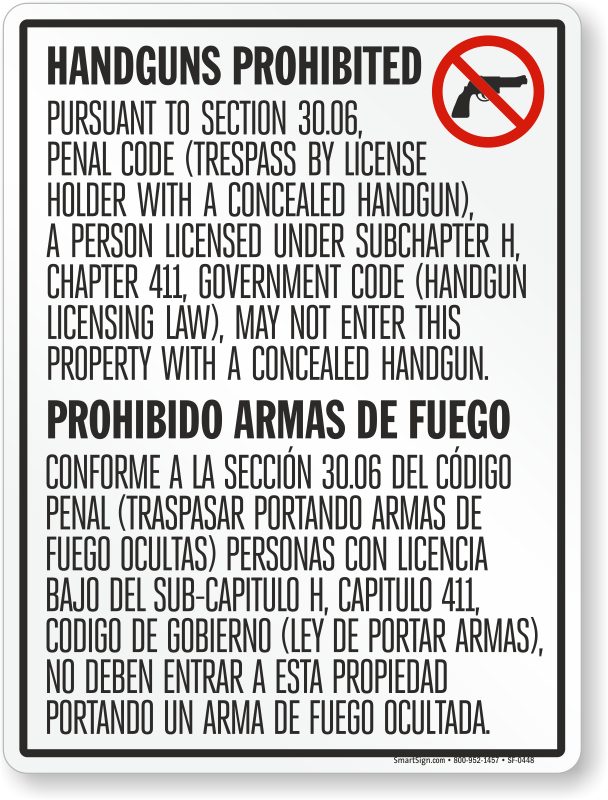
Private Property. Legal Notice. Real Consequences.
In Texas, businesses and property owners have the right to restrict firearms on their premises. When proper notice is given, carrying a weapon into a prohibited space can become a criminal offense. The details matter. So does the notice.